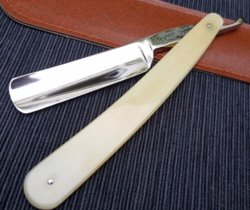
Use a good solid desert spoon lightly tap the pins alternating both sides better to hit the pins 200 times lightly than 20 times with to much force just be careful. And yes I have had many Ivory razors in for honing and restoration, if they only come in for honing and the blade is very loose then I contact the owner and tell them I won't attempt to tighten the pins just in case the Ivory breaks for restoration I use a very small stainless steel washer so small in fact you cannot see it once then pin head as been peened and formed.
Take Jamie's advice regarding light taps - you do need to have a razor that relatively tight otherwise you risk the same problems of a potential split by gripping the scales too tightly when stropping.
There are some techniques for avoiding a split when pinning - one is to use washers as this helps spread the load when tightening the pivot pin - also, you can put a small countersink in the hole which again helps to spread and accommodate the 'mushroom'. In your case this isn't an option - unless it was already there originally.
As regards horn - it's pretty sturdy stuff and of the countless scales I've made I've never had one split. You do see old horn scales with splits but these have probably dried out in the 100 - 200 years they've been in use.
I've heard it said that honing loosens the pins, especially with new pins, after a restoration. If that is the case, I assume it's the concussive effect that "wiggles" them a bit loose.
Would you deal with that in the same way - or similar - as Jamie mentioned above (the spoon), after it's finished or check and do it throughout the progression? Or either / both depending on the situ, 'cos over-tightening the pins before honing, to correct for the loosening effect, would be risky .
I assume (again) you want some very small, almost imperceptible amount of "give" because if the pins are too tight / rigid, that would increase the pressure on the pin hole and increase risk of splitting.


 214 KB Views: 377


